
If you were to make a guess at how long woodturning has been around, what would you say?
The team at Tas Turning Supplies made guessed ranging between 200 years and 350 years with one rogue guess at 1,000 years!
Maybe you'd guess 100 years, since electricity made the powered lathe accessible to the everyday maker? Perhaps 200 years, since the industrial revolution brought steam power and mechanised manufacturing to the world? You might even go bold and say 500 years.
The answer may surprise you.
Woodturning is at least 3,000 years old. Possibly older.
The Egyptians Were Turning Timber
The earliest evidence of woodturning takes us all the way back to ancient Egypt, around 1300 BC. Archaeological discoveries have uncovered turned wooden objects from this era, bowls, furniture components and decorative pieces that show a remarkably sophisticated understanding of the craft.
The Egyptians used a two person lathe. One person pulled a cord back and forth to spin the workpiece while the other held the cutting tool against the rotating timber. Simple by today's standards, but the fundamental principle of spinning timber against a fixed tool to shape it is exactly the same principle your lathe uses today.
Think about that for a moment. The woodturner in their shed on a Saturday morning in suburban Australia is doing something a craftsman in ancient Egypt was doing over three thousand years ago.
The Greeks, Romans and the Spread of the Craft
From Egypt, woodturning spread rapidly through the ancient world. The Greeks and Romans took the craft further, refining techniques and developing foot powered lathes that allowed one person to both spin the timber and shape it simultaneously, a significant leap forward from the two person Egyptian method.
By 700 BC the craft was widespread across the known world. Excavations in modern day Italy, Turkey and Germany have all uncovered turned wooden artefacts from this period, telling us that woodturning wasn't a local curiosity. It was a fundamental human skill practised across civilisations.
Medieval Bodgers and the Pole Lathe
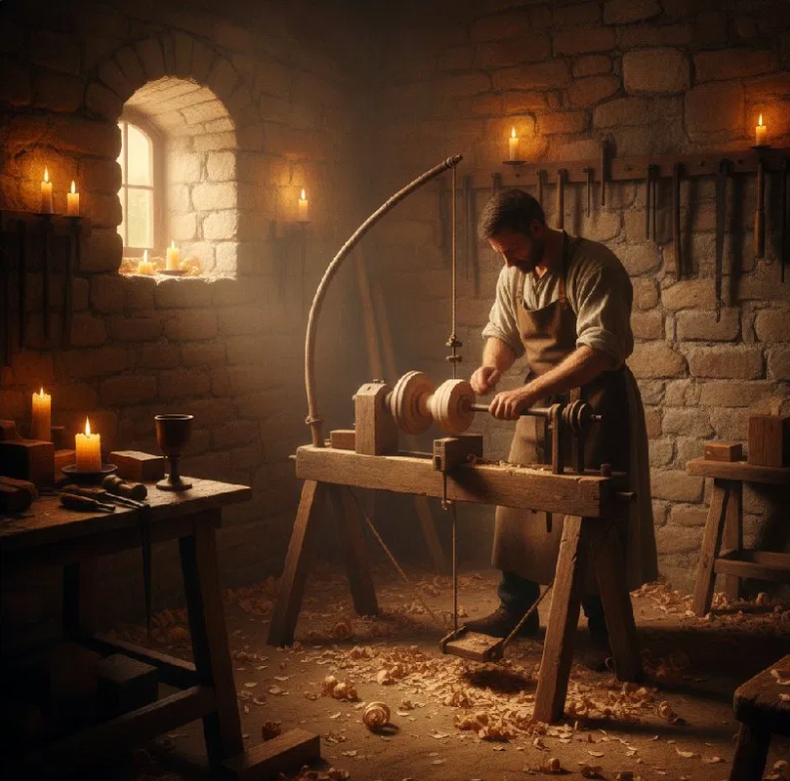
Through the medieval period, woodturning evolved further with the pole lathe, an ingenious device that used the springiness of a long flexible pole to return the workpiece after each cutting stroke. The turner would press a foot treadle to spin the wood toward them, make their cut, then release to let the pole spring back.
No external power. No electricity. No steam. Just a turner's leg, a flexible pole, and skill.
Bodgers, itinerant craftsmen who worked in the forests of England, used pole lathes to produce chair legs and spindles on the spot, often working among the very trees they were felling. The pole lathe is still used today by traditional woodturners who value the connection to the craft's ancient roots.
Steam, Electricity and the Modern Era
The industrial revolution of the 18th and 19th centuries brought steam power to the lathe, transforming woodturning from a hand powered craft into a mechanised industry. Mass production became possible for the first time. Turned wooden components could be produced in quantities that hand turners could never have imagined.
But something was lost. The individuality, the uniqueness, the mark of the maker's hand, all of that disappeared into the factory.
By the end of the 1800s, electric motors had become the power source of choice for lathes, and the hobby woodturning movement began to grow. Suddenly the lathe was accessible not just to professional craftsmen but to anyone with a shed and a power point. Woodturning clubs formed. Competitions were held. The craft that had been practised for three thousand years found a new generation of enthusiasts.
Where We Are Now
Today woodturning is a growing art, and we see it every day at Tas Turning Supplies.
Retirees discovering the lathe for the first time. Young people stepping away from screens and into the shed. Complete beginners picking up a lathe off Facebook Marketplace and starting with turning a small bowl from a piece of firewood.
Three thousand years of human history, distilled into a morning in an Australian shed.
The tools have changed. The power source has changed. The speed and precision of the modern lathe would astonish an Egyptian craftsman or a medieval bodger.
But the fundamental impulse, to take a spinning piece of timber and shape it into something beautiful with your own hands, that hasn't changed at all.
It never will.
Photo is an artists impression used with permission.